Bruce Johnson and Martin Cloonan
Dark Side of the Tune: Popular Music and Violence
(Adlershot: Ashgate 2008)
Review by Carlo Nardi
In his book The ragas of North India, Walter Kaufmann reports a conversation he had in 1934 with an eminent classical musician in then Bombay. On the basis that a rāga performed at a wrong time is inauspicious, the old man expressed his sense of frustration in these terms: “Do you know that you people in the West will soon experience a most terrible disaster? And do you know why? […] Because you people in the West abuse music and perform it at wrong times and occasions! You play funeral marches and sing dirges when there is no funeral and no cause for sadness, you sing love songs and spring songs when there is neither love nor spring, you play nocturnes during the day, wedding music when there is no wedding. How long – he roared – will the universe tolerate this abuse of music, music, mind you, a most sacred thing?” (Kaufmann 1968, p. 18). Continue reading
Twenty Years After: A Review Essay of Musicological Identities
Michael W. Morse
Twenty Years After: A Review Essay of Musicological Identities (1)

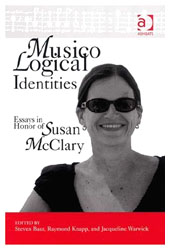
Steven Baur, Raymond Knapp, and Jacqueline C. Warwick (eds)
Musicological Identities: Essays in Honor of Susan McClary
(Aldershot, England; Burlington, VT: Ashgate, 2009) (2)
i
It has been nearly twenty years since the publication of Susan McClary’s provocative Feminine Endings. The appearance of a festschrift, with contributions from her most reliable students and acolytes, presents a suitable occasion to rethink the contribution to musicology of McClary and her school. I believe, first of all, that we can speak straightforwardly of a ‘school’. There are a number of important orientations, principles if you will, that unite these authors in their diversity, marking them together ideologically, and apart methodologically from other versions of musicology; they form a major strand of the so-called New Musicology® (3). Historically, perhaps first among these principles were regular and fervent proclamations of ideological distance from (and hence disinterest in) ‘traditional’ musicology and its outmoded scholarly paradigms; such edicts often took the form of tabular lists of the virtues of ‘us’ and the flaws of ‘them’ (4). Musicology’s paradigm—the singular is deliberate—is considered methodologically superseded because it ignored social context in favour of a chimerical abstract called ‘the music itself’, and morally outdated because it espoused elitist canons of white male privilege, intellectually as well as musically. Continue reading
Borderless Ethnomusicologies
The Society for Ethnomusicology
2009 Meeting
Call for Proposals
The Society for Ethnomusicology will hold its 54th annual meeting on November 19-22, 2009, in Mexico City, hosted by Centro Nacional de Investigación, Documentación e Información Musical Carlos Chavez del Instituto Nacional de los Artes; Escuela Nacional de Música, Universidad Autónoma de México; Escuela Superior de Música, Instituto Nacional de los Artes; Museo Nacional de Culturas Populares de la Dirección General de Culturas Populares; Escuela Nacional de Conservación, Restauración y Museografía of the Instituto Nacional de Antropología; Comisión de los Pueblos Indios; Fonoteca del Centro Nacional de las Artes of the Consejo Nacional para la Cultura y las Artes; and the Secretaría de Cultura del Departamento del Distrito Federal.
Continue reading
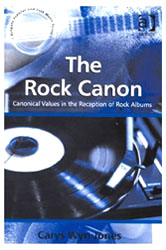
Carys Wyn Jones (2008) The Rock Canon
Carys Wyn Jones
The Rock Canon: Canonical Values in the Reception of Rock Albums
(Aldershot: Ashgate, 2008)
Review by Maria Hanáček

The ongoing debate over the concept of a Western canon keeps various disciplines occupied and popular music studies certainly are no exemption. This academic debate is not the main frame of reference of this book, though. It is concerned with the emergence of canons – seemingly a high art concept – in popular culture and examines the extent to which canonical models from literature and classical music inform the reception of rock albums.
The study focuses on ten albums repeatedly appearing in “greatest albums” lists. The term “rock”, however, is applied very broadly here to “music defined primarily by albums”, thus this top ten includes not only the Beatles and the Rolling Stones but also Marvin Gaye and the Sex Pistols. (This definition appears quite plausible if one considers that “classical” concepts and values are most likely to be found in albums, which come close to the idea of a work of art. It seems a bit problematic, though, when later on an “ideology of rock” with narrower genre connotations is employed). Continue reading
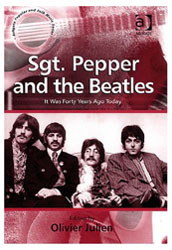
Olivier Julien (2008) Sgt. Pepper and the Beatles
Olivier Julien (ed.)
Sgt. Pepper and the Beatles: It Was Forty Years Ago Today
(Aldershot and Burlington: Ashgate, 2008)
ISBN: 978-0-7546-6708-7 (Paperback)
ISBN: 978-0-7546-6249-5 (Hardback)
Review by Alison Notkin

The Beatles are a popular band. During their reign as the “Fab Four” in the 1960s they were a popular band, and thirty-eight years after their ten-year career ended, they are still a popular band. More books have been written about the Beatles than any other band, ever. They were the first band to “warrant” serious musicological writing, and in fact, are one of the only popular music groups to grace the pages of such auspicious publications as the Cambridge Music Handbooks (only the Beatles and George Gershwin have had this honour so far). Music-lovers I meet often tell me that the Beatles are by far the best band that ever existed, and certainly, I, who spent hours of my 1970s and 80s childhood, locked in my basement, listening to records and pretending to be John Lennon, cannot contest that statement. Come to think of it, it is because of the effect of this popularity that I am even here, writing this review that I jumped on once hearing what the topic of the book was. Continue reading
Don’t fence me in: Borders, frontiers, and diasporas
IASPM-US 2009 Conference
University of California, San Diego
May 29-31, 2009
San Diego, CA
The deadline for submission of abstracts has been extended to December 22
Borders, boundaries, and frontiers have intersected and interacted with popular music in differing ways, times, and places, and oftentimes these relationships have been particularly resonant in diasporic communities. Taking an open-ended approach to borders and boundaries as types of thresholds and to frontiers as kinds of liminal zones, this conference seeks to explore their significance in popular music in terms of the aesthetics of genre and style, the politics of personal and social identity, and the dynamics of time and place. Potential issues for discussion include technology, media, industry gatekeepers, changing business practices, gender, migration, ethnicity, nationality, language, and changing definitions of music that involve region and era. The program committee of the 2009 conference of IASPM-US invites proposals for papers, panels, or roundtables relating to these ideas and, of course, welcomes proposals on any aspect of popular music. Continue reading
Sound Property? Investigating the Legal Status of Sound Recordings
An Interdisciplinary Conference on Music & Copyright
University of Salford, UK February 18-19, 2009
This conference proposes to investigate the current U.S. and U.K. statutes that regulate the protection of sound recordings. It will inquire to what degree those laws secure the rights of both the owners and creators of the music contained on these products as well as determine their impact upon those who consume and comment upon this material. The pending efforts to universalize an extended term of copyright underscore the potential for even more draconian controls upon recorded music. Will the public, creators, and commentators continue to be able to acquire, appreciate and appropriate musical materials? Can some balance be found between the need for profit and the pursuit of pleasure? Is it possible in a civil society for music effectively to be silenced through constraints over its recorded legacy?
Continue reading
Job at the Faculty of Fine Arts, University of Agder
Professor/associate professor/assistant professor in vocal performance in popular music at the Faculty of Fine Arts, University of Agder
Ref nr 108/08
The University of Agder invites applications for a full time permanent position as Professor/Associate Professor/Assistant Professor in Vocal Performance in Popular Music at the Department of Music, Faculty of Fine Arts. The position is currently located at Campus Kristiansand, Norway.
The successful applicant must have higher (master’s) degree in music, and must be able to demonstrate a high level of artistic ability in vocal performance in popular music. Credit will be given to relevant research and development experience. Continue reading
The bolero in Caribbean culture and its worldwide circulation

The Ministry of Culture of the Dominican Republic, the Eduardo León Jimenes Cultural Center (Centro León) and the Institute of Caribbean Studies (INEC) announce the International Conference “The Bolero in Caribbean Culture and Its Worldwide Circulation,” to be celebrated April 17, 18, and 19, 2009, in the facilities of the Centro León, in Santiago de los Caballeros, Dominican Republic.
This is the third edition of the conference Music, Identity, and Culture in the Caribbean (MIC), which has been declared an “Event of High Cultural Interest” by the Ministry of Culture of the Dominican Republic. Continue reading
Fabian Holt (2007) Genre In Popular Music
Fabian Holt
Genre In Popular Music
(Chicago: University of Chicago Press, 2007)
Review by William Echard (Carleton University)

As Holt glosses it: “this is a book about the work of genre categories in American popular music” (p. 1). In part the book is a theorization of genre as a site of cultural practice, and in part a series of case studies. Holt’s own goals relative to the existing literature are to “bring genre scholarship closer to musical practice and experience,” and also to understand music genres “in the totality of social space” (p. 7). He adopts the term genre culture “as a concept for the overall identity of the cultural formations in which a genre is constituted” (p. 19). And given the complexity of social space, Holt feels that “the best way to [study genre] is not to develop an all-encompassing master theory, [but rather to] employ multiple critical models, explore plural narratives, and develop ‘small theories’ in relation to particular musical and social realities in a series of individually designed case studies” (pp. 7-8). Continue reading