Heavy Metal and Disability, Volume II: Blessed are the Sick

Heavy Metal and Disability, Volume II: Blessed are the Sick

Co-Editors: Jasmine Hazel Shadrack and Keith Kahn-Harris.

Call for Papers:

Trauma and disability are [often] discussed in similar terms. Trauma results from a profoundly distressing experience—war, abuse, migration, a sudden death—and is often the focus of therapeutic efforts to heal and become “normal” again. Disability references a number of physical and mental conditions that render a body impaired or disabled, and thus not “normal.” Both trauma and disability are regarded as life-altering states that not only reconfigure the mind and body but may also impact a person’s capacity to feel pleasure, develop coping mechanisms, and interact with the world. (Storti, A., 2021)

Our volume, Heavy Metal and Disability: Crips, Crowds, and Cacophonies (Intellect, 2024) was intended to be the start of an important conversation on the myriad ways in which metal music and its culture intersects with various ontological and epistemological experiences of disability. Yet one edited collection alone was never going to be able to do justice to the great many experiences and conversations on this topic that deserve to be heard. As Anna Storti states above, trauma and disability are regarded as life-altering states’ (ibid), so we now wish to expand and continue that conversation.

As a concept, disability intersects with a variety of other concepts, all of which are contestable, contested and also indispensable: Sickness, injury, pain, trauma cannot be disengaged from disability but nor are they reducible to it. In this volume, therefore, we encourage work that explores the ambiguities and ambivalences that arise when disability and related concepts are applied to real world cases.

Metal, of course, is a similarly contested field, with its own contested terminologies and boundaries. Indeed, metal is often seen as a culture defined by the crossing and troubling of boundaries. Therefore, in this volume we seek to encourage work that relates metal’s boundary-crossing with the boundaries of disability and ability, sickness and health, pain and comfort, and so on. Above all, we encourage perspectives that centre the body in understanding metal culture – and the limits of the contested metal body.

This call for papers invites abstracts on the following areas of metal music studies and disability studies:

  • The ways in which physical disabilities intersect with metal music and its culture, whether innate* or acquired
  • The ways in which sensory disabilities intersect with metal music and its culture, whether innate or acquired
  • The ways in which co-occurring diagnoses impact engagement with metal music and its culture

* We use the term innate specifically to mean ‘born with’ and to replace the medical model of disability’s language of ‘congenital’. We feel that ‘congenital’ has connotations imposed upon it from the medical profession (top-down power differential), rather than a disability activist position (bottom-up maneuverability and reclamation). Unfortunately, there is a paucity of good faith terminology regarding disability and to couch against this, we have chosen ‘innate’ as a more loving language replacement. 

  • Differentiated engagements with metal music and its culture in relation to:
  • Sickness
  • Injury
  • Performing/touring/participating whilst sick/disabled
  • Exhaustion/Fatigue
  • Pain
  • Listening/Hearing
  • Seeing
  • Participating
  • The ways in which age-related diagnoses intersect with metal music and its culture
  • The ways in which engagement with either/or metal lyrics and music speak of and to disability
  • The ways in which the following intersect with metal music and its culture:
  • Fat Studies
  • Identity Studies
  • Trauma Studies
  • Disability/Crips Studies
  • Death Studies
  • Grief Studies

Please submit an abstract of no more than 500 words to both jasmine.shadrack@uwo.ca and keith@kahn-harris.org by 1st September 2026.

Bibliography

Storti, A., M., M. (2021). ‘Abuse and/as disability in Leah Lakshmi Piepzna-Samarasinha’s Dirty River’ in Disability Representation in Film, TV, and Print Media, edited by Michael S. Jeffress, London: Taylor & Francis Group.

BFE/RMA Research Students’ Conference 2027 – Call for Proposals

The British Forum for Ethnomusicology (BFE) and Royal Musical Association (RMA) Research Students’ Conference will take place at the University of Oxford from Wednesday 6 – Friday 8 January 2027 as an in-person event hosted at the Schwarzman Centre for the Humanities.

The conference welcomes postgraduate research students across all areas of music research, including (but not limited to) ethnomusicology, musicology, sound studies, composition, performance, jazz and popular music, music psychology, audiovisual media, critical editing, and interdisciplinary or creative practices.

Alongside academic papers, the conference will feature workshops, roundtables, poster exhibitions, practice-based opportunities, composition talks, social musicmaking, and access to the Bate Collection of Historical Instruments and Oxford’s performance facilities.

Keynote addresses will be given by Jerome Roche Prize winner Peter Asimov, the BFE keynote speaker (tba), and the Tippett Medal recipient (tba).

Call for Proposals
Deadline: Friday 4 September 2026
Submission form link: coming soon

Formats include:

  • Academic Papers 
  • Lecture-Recitals
  • Themed Panels/Roundtables 
  • Poster Presentations
  • Compositions

The conference is a unique context to test out ideas, experiment with new research routes and find new colleagues interested in your same topics, providing a vibrant, supportive, and welcoming environment for presenting research, compositions, performances and creative work, while fostering connections across music disciplines.

As part of the BFE and formerly an attendant of the conference, I have always found it to be one of the most fun, innovative and stimulating ones in the UK. Please, if you’re a supervisor or cover a similar role, consider suggesting this conference to your students.

We look forward to welcoming you to Oxford in January 2027.

More information here: https://www.music.ox.ac.uk/event/2027-bfe-rma-conference

 IASPM International conference

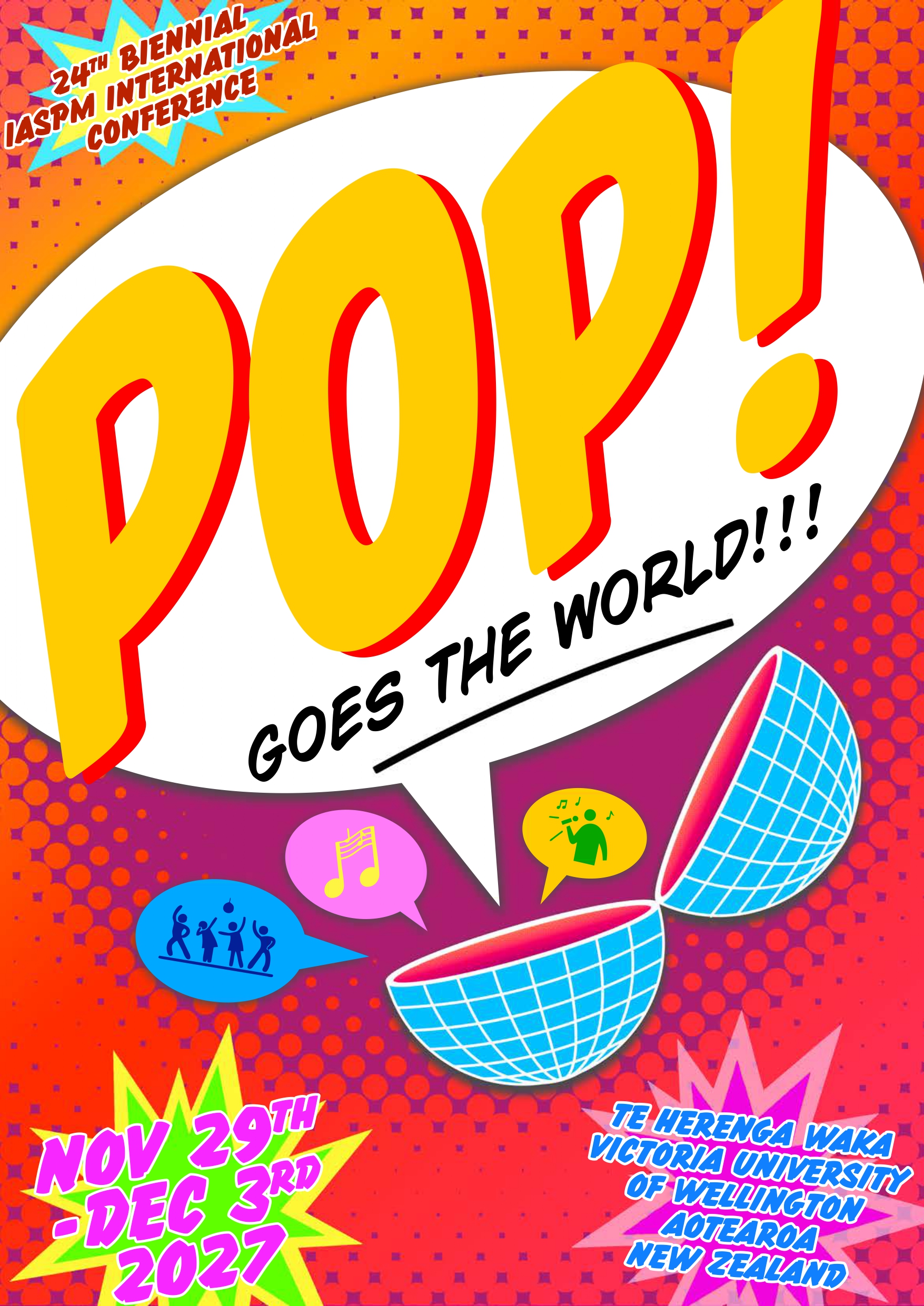
Pop! Goes the World!!!

24th Biennial IASPM-International Conference

Te Herenga Waka/Victoria University of Wellington

Te Whanganui-a-Tara/Wellington

Aotearoa/New Zealand

November 29-December 3, 2027

‘Pop goes the world’, Montreal’s Men Without Hats once sang. A quaint ditty about a couple, Johnny and Jenny, in a band named ‘The Human Race’ searching for meaning and salvation in a pop career. It served as a tribute to the power of popular music as a diversion, but also a possibility, an entry point into another way of life, another world. Riffing on this, the 24th biennial IASPM-International conference aims to honour the ‘pop’ in popular music but ground it, much like our song’s protagonists, in the human race. If one version of ‘pop’ is about the disposability, ephemerality and escapism of certain forms of popular music, other versions want to hold on to its pleasures, its ability to lift people up, through individual and collective empowerment. And, more so, ‘pop’, of course, also points to both a fragility and an explosiveness, a calamitous bursting. In a world riven with precarity, uncertainty, and the political vicissitudes of mercurial leaders, a world threatening to go ‘pop’ also carries with it a visceral sense of inescapable existential urgency. 

These are just some of the many valences of ‘pop’, but they serve as starting points for a range of provocations and sites of interrogation. We can ask, for example, how do we, as popular music scholars, music-makers, listeners and fans, contend with these differently charged notions of ‘pop’? Across the many worlds we straddle, in our research, writing, creative practices, politics, pedagogy and our lives, how do these multiple senses of ‘pop’ resonate and synergize? What are some of the challenges and promises we face when we try to grapple with and harness the semiotic charges of ‘pop’ in these diverse arenas? What, we might ask at this critical juncture, are some of the ways popular music and popular music studies can be made to ‘pop’ in times of crisis?

With these prompts in mind, the organisers of the conference welcome papers and panels that draw on the following themes:

  • Tutira Mai Ngā Iwi: Popular Music and Indigenous Imaginaries
  • Clandestino: Music, Migration and Mobility 
  • Prisencolinensinainciusol: The Cultural Politics of Musical Translation
  • Broken Pieces Shine: Popular Music and Disability
  • That’s Me in the Corner: Making Music at the Margins
  • Tous les garçons et les filles: Music and Young People
  • Wir sind die Roboter: Music Technologies from Analogue to AI and Beyond
  • Náttúra: Music, Environments, Ecologies and Sustainability
  • 夜上海: Popular Music Historiography, Recording Industries, and the Politics of Genre
  • Désenchantée: Music and Mental Health
  • We Don’t Need No Education: Academic Life, Pedagogy, and Popular Music
  • Apesar de você: Local and Global Activism, Protests, and Popular Music
  • 하루하루: Popular Music and the Everyday
  • Life in One Chord: Performing and Producing Popular Music

The organisers also welcome papers and/or panels on popular music that do not directly address these themes.

We are seeking abstracts of 200-250 words. Please format them as either Word or Google Docs, not PDFs, and label them lastname_firstname. Abstracts should include 3-5 keywords, indicate 1-3 preferred themes, provide a brief bio (max. 100 words), and institutional affiliation, where applicable. If submitting a panel (3-4 papers) be sure to supply a panel brief and the abstract for each participating panellist. Practice-based presentations will be considered but may be subject to tech availability. Please specify your tech needs in your abstract, and we’ll follow up where necessary.

All presenters must be members of IASPM prior to the start of the conference. You can find details on how to join here: https://www.iaspm.net/how-to-join/

Abstracts can be sent to: iaspm2027@gmail.com. Submission deadline: December 1st, 2026. Applicants will be notified of acceptance no later than April 1st, 2027.

Call for Papers – A Collection on Faith No More (title tbc)

Co-Editors: Jasmine Hazel Shadrack and Samuel Thomas

Background & Rationale: Faith No More are widely regarded as one of the most important and singular bands to make the transition from the 1980s underground to the Billboard Hot 100 and a period of MTV-approved visibility. As idiosyncratic as they are influential, the band are in many respects defined by a series of tensions or contradictions. Faith No More are often framed as the quintessential “alternative metal” act, for example, but can trace their roots back through the San Francisco art rock and postpunk scenes (as recently chronicled by Will York in Who Cares Anyway) and have always demonstrated a strikingly promiscuous approach to genre. Their history stretches from a vibrant debut record released in 1985 (out-of-print for a period of 20 years) to their 90s flourishing and disintegration to a 2015 comeback (perhaps also their swansong) that provides a powerful riposte to the imaginative bankruptcy of so many late-middle-age reunions. They have endured significant line-up changes and much-documented interpersonal fractiousness while at the same time maintaining a remarkably distinctive and consistent musical backbone: the melodies and deftly atmospheric keyboard textures of Roddy Bottum; the groove and throb of Billy Gould’s bass; the thunderous, tom-driven polyrhythms of drummer Mike “Puffy” Bordin. Their albums encompass genuine sonic extremes, often bringing together unlikely combinations of sounds and styles, but also function as coherent and accessible musical statements that blur the lines between the popular and avant-garde. In their commercial heyday, the band shared stages with some of the largest acts in heavy music, most infamously as part of a 1992 arena tour co-headlined by Guns N’ Roses and Metallica, while choosing to collaborate with artists as dissimilar as the Boo-Yaa T.R.I.B.E. and Sparks. In the same year as that tour, they released a double A-side single that paired “Be Aggressive,” a song about gay oral sex, with a cover of “Easy” by the Commodores. Faith No More’s music is undoubtedly marked by a specific brand of Gen-X irony and subversive humour but is executed with the great sincerity and care, as it were, that comes from deeply committed musicianship and an authentic band dynamic. The two singers that feature on their recorded output — Chuck Mosely and Mike Patton — could not be more different yet both point to compelling new ways of thinking about lyrics, performance/persona, and vocal experimentation in a rock/metal context. Despite first rising to prominence in the US with a platinum record (1989’s The Real Thing), the band’s most dedicated and receptive fanbases developed in South America, Australasia, and the UK.

Given the scope and scale of popular music studies today, not to mention widespread scholarly interest in the (long) 1990s, it is surprising that Faith No More have received such scant academic attention. This collection seeks to address a significant gap in scholarship and the editors therefore invite contributions to a path-finding project. The collection will be the first to critically engage with the musicological and cultural/historical significance of Faith No More — with the origins, evolution, and legacies of a unique, risk-taking, category-befuddling band.

We have identified the following broad areas as a provisional framework for the collection:

Contexts

Music-Making / Making-Music

Reception

Within this framework, we foreground potential topics such as:

  • File under “unclassifiable”? Faith No More and the cultural politics of genre (esp. in relation to the norms of rock and metal or the concept of the “alternative”)
  • San Francisco localism vs. the band’s special relationships to a variety of global scenes and audiences
  • Starting a joke? Irony and humour / sincerity and caring (a lot or not)
  • Musicological analysis and the nuances of Faith No More’s songcraft (including instrumentation, production, authorship etc.)
  • Significant live performances and tours
  • The band’s music videos and presence on MTV
  • Faith No More and the music press / music industry
  • Consistency, transition, and flux: The 80s, the 90s, and the band’s 21st century reformation
  • Faith No More’s multi-faceted influence and role as a “gateway” band to other genres and subgenres

Please submit an abstract of no more than 500 words to both editors by 31st October 2026.

Jasmine.shadrack@uwo.ca

samuel.thomas@durham.ac.uk

Rhythm under the Microscope II: An Interdisciplinary Conference on Microrhythm and Tempo Variability in Popular Music

Rhythm under the Microscope II: An Interdisciplinary Conference on Microrhythm and Tempo Variability in Popular Music

Location: University of Music and Performing Arts Vienna, Institute of Popular Music

Submission Deadline: Monday, June 1, 2026

Starts: Thursday, October 22, 2026

Ends: Saturday, October 24, 2026

In September 2024, scholars gathered at the University of Music and Performing Arts Vienna for Rhythm Under the Microscope, a conference examining microtiming and groove in popular music. Keynote speakers Anne Danielsen and Justin London explored the effects of a variety of parameters on the perception of microrhythm as well as the relationship between rhythm and microtiming. Other paper presentations and workshops further examined aspects of timing, groove, and aesthetics.

Rhythm Under the Microscope II is a sequel to the 2024 conference, providing an opportunity for renewed study of microtiming, including scholarly advances since the first conference, but also opening up to discussions of tempo variability. The conference seeks to bring together musicians and scholars from various disciplines to connect their different perspectives and further the current state of microrhythm, tempo variability, and groove research. Fernando Benadon and Ragnhild Brøvig have been confirmed as keynote speakers for the 2026 conference.

We invite proposals for paper presentations and workshops. Paper presentations should be 25 minutes long, with an additional 10 minutes allotted for questions and answers. We also encourage scholars to submit ideas for 90-minute workshops in which a group of participants would have the opportunity to learn about current research or pedagogical methods and implement them in a hands-on fashion. Artistic research is also highly welcome. Applicants can submit a maximum of one presentation proposal and one workshop proposal.

Topics of proposed papers and workshops might include but are not limited to:

  • New methods for measuring microrhythmic phenomena and tempo variability
  • Microrhythm and bodily movement
  • Perception of microrhythm and tempo variability and the neurological bases for these
  • The effect of timbre, pitch, duration, etc. on the perception of groove
  • Manipulation of microrhythm or tempo variability in digital music creation
  • Relationships between the timing of multiple instruments in a band, played live or manipulated in the studio
  • Expressive timing in rap vocals
  • Teaching microrhythm or tempo variability in music education
  • Microrhythm or tempo variability in specific pop or rock genres, folk musics, or jazz
  • Identifying microrhythmic or tempo “fingerprints” of famous recording artists

Please submit your abstract by June 1, 2026 to rhythm-ipop@mdw.ac.at. Abstracts should be between 400 and 700 words (references not included in the word count).

Authors will be notified of acceptance by mid-June. For further information, please contact rhythm-ipop@mdw.ac.at. Details about registration will be forthcoming.

FACT FICTION

FACT FICTION

Interdisciplinary Research and Development Programme

New Music Research Institute Amsterdam

The New Music Research Institute Amsterdam in collaboration with .abeceda Institute invites applications to FACT FICTION, an interdisciplinary research and development programme for students and professionals—including composers, performers, scholars, educators, makers, artists, producers, curators, and emerging practitioners—who seek to formulate, prototype, test, refine, and mobilise original research through artistic practice, analytical inquiry, and critical reflection within a sustained international research community.

Led by Dr Alastair White, the programme is structured across three pathways: Introduction to ResearchYoung Researchers, and the Advanced Research Group. These pathways support successive stages of research development, from foundational orientation and methodological formation to original proposal design, portfolio construction, doctoral preparation, advanced interdisciplinary analysis, and sustained peer review.

Research projects evolve through structured presentations, critical dialogue, peer review, and iterative refinement. Organised around the concrete questions, materials, methods, and challenges emerging from individual and collective work, the programme operates as a dynamic research ecosystem—supporting long-term project development while creating clear conditions for the articulation, application, and dissemination of research outcomes, including substantive contributions to artistic and scholarly knowledge.

All participants are invited to engage with Bled Contemporary Music Week (Slovenia, EU), which provides an intensive context for public presentation, interdisciplinary exchange, and reflective development. Selected research reports and articles may be published in the annual edition of the Journal of New Music Research and Development, produced by infra.norma.meta Amsterdam and Verso Doxa produced by .abeceda Institute.

APPLICATION:

The New Music Research Institute Amsterdam is a research and development centre led by infra.norma.meta (Netherlands, EU) and realised in partnership with the .abeceda Institute (Slovenia, EU). It operates as an international platform for artistic research and innovation, providing a structured, research-driven framework for students, early-career professionals, and established practitioners to conceive, prototype, test, critically evaluate, and disseminate original research projects through sustained practice, rigorous peer exchange, and concrete professional application.

The .abeceda Institute is a Slovenian research, production, and development platform for contemporary music, structured through residencies, concerts, festivals, mentoring, publishing, and documentation. Since 2020, it has built a sustained infrastructure for artistic research, creation, performance, and dissemination, presenting more than 200 concerts alongside talks, workshops, recordings, publications, and audio releases. Anchored by the .abeceda New Music Ensemble and Bled Contemporary Music Week, the Institute works with key Slovenian and international partners through projects including precept.concept.perceptenuntiatio.praefatio.formulae, and the .abeceda [New Music Academy], supporting composers, performers, conductors, researchers, and music practitioners in developing, testing, evaluating, and sharing new artistic practices.

«Everybody calls me Giorgio»: Moroder across media, arts and communication

«Everybody calls me Giorgio»: Moroder across media, arts and communication

Brixen, Faculty of Education, University of Bozen-Bolzano

10-12 September 2026

IASPM Italia + IASPM D-A-CH

Call for papers

Giorgio Moroder’s biographical and professional history is remarkable and quite peculiar: belonging to a linguistic minority, raised in a region culturally and geographically removed from the main centres of the music industry, without any formal musical education, he nonetheless managed to become one of the most innovative and successful musicians on the planet.

This conference will be an opportunity to take a closer look Giorgio Moroder’s role in music and media, as well as broader, interconnected themes such as dance music, studio production, arts entrepreneurship, film music, intermediality, and remix cultures. The conference will also explore cultural heritage, sociolinguistics and migration routes in music and the arts, drawing on Moroder’s history as an artist born and raised in the predominantly Ladin-speaking Val Gardena/Gröden/Gherdëina in South Tyrol, Italy, then professionally matured in Germany and eventually relocated to the United States.

In addition to presentations dealing with various aspects of Moroder’s life and work, we welcome papers that address the context in which he operated or which he affected. In fact, we propose that Moroder and his achievements could serve as a starting point to explore some fundamental changes in the music industry starting at least from the last quarter of the twentieth century.

We invite submission moving from or focusing on Moroder and covering topics such as:

• The role of technology and the redefinition of professional roles in the recording studio.

• Looping, sequencing and synthesizers and the emergence of new musical genres, • particularly in dance music.

• The role of the composer in technology-based music genres.

• Western Art music influences in dance music.

• European music production hubs.

• The imagery and discourse of dance music.

• Dance music and queer culture.

• Dance music, the racial formation of the ‘Black voice’.

• Electronic sound, technology and embodiment.

• Gender politics and hypersexualization of artists.

• The emergence of DJs as performers and mediators.

• Ageing in the club scene.

• Artist aliases.

• The artist as a symbol for a specific kind of music, nation, language, city, etc.

• New models of entrepreneurship in the arts, particularly in music.

• Discothèques, Schlager, electronic music and the roots of Eurodisco.

• The emergence of new actors in the European music industry.

• Cultural appropriation and labour exploitation in the European music industry.

• Hybridisations and remediation between music, film and television in terms of styles, formats, distribution, audience, etc.

• Synergies between music, film, television, and new media.

• Film rescoring and pop aesthetics in the adaptation of archival material.

• Remix cultures and musical works.

• Remembering artists of the past in songs, the press, films, etc.

• Translation and localisation: adapting songs for different national markets.

• Formal, non-formal and informal music education in multilingual and culturally hybrid and trans-national spaces.

• Histories and historiographies centred around important people, musical practices, listening practices, instruments, and materials.

• Ties to and estrangement from one’s homeland: language, heritage, networks.

• The musical branding of sport mega-events.

The conference venue in Moroder’s homeland offers the opportunity to involve local organizations, such as the Department of Ladin Education, Training and Culture, as well as to retrace the career of the artist from Scurcià, Urtijëi, exploring his formative and migratory journey which, especially since the 1960s, has involved many well-known and lesser-known figures in the fields of culture and entertainment. IASPM Italia and IASPM D-A-CH, acting jointly as the organising committee, will create a bridge across the Alps, metaphorically recreating one of those routes.

Keynote speakers: Ewa Mazierska (University of Lancashire); Tavia Nyong’o (Yale University).

Guest panellists: Mark J. Butler (Humboldt-Universität zu Berlin); Paul Harkins (Edinburgh Napier University); Julin Lee (Hochschule für Musik und Theater München).

Other special guests and side events will be announced soon.

Important information:

The conference will start at 14:00 on Thursday, 10 September 2026 and will close at 13:00 on Saturday, 12 September 2026.

Please submit your abstract by 15.05.2026 to ECMG26.unibz@gmail.com

Confirmation will be sent by 31.05.2026

Please select the type of contributions (paper, panel, poster) and indicate one or more streams:

• Dance music and club culture

• Music production and technology

• Music for screen

• Archiving, cultural heritage and historiographies

• Music composition between formats, styles and genres

• Sociolinguistic and semiotics

In parallel with the main event, the conference committee will publish a call for contributions for an edited book on the conference topics. The language of publication will be English. The book is expected to be published in 2027.

Registration fees: presenter: 75€ (waged); free (unwaged) || attendee: 50€ (waged); free (unwaged)*

* Waged: scholars with a permanent, tenure-track or research fellow waged position, employed workers, entrepreneurs, etc.; unwaged: PhD candidate, students, independent scholars, unemployed, etc.

The registration fee includes coffee breaks and buffet lunch on 11.09.

Registration: from 01.06.2026 to 15.07.2026 (presenter); from 01.06.2026 to 05.09.2026 (attendee).

To present at an IASPM conference, you need to become a member.

Hotels have been pre-booked for the participants. Details will be available on the conference website.

Organizing committee: Carlo Nardi and Ruth Videsott (Free University of Bolzano-Bozen), IASPM Italia and IASPM D-A-CH.

Scientific committee: Ulrich Adelt (University of Wyoming); Emília Barna (Budapest University of Technology and Economics); Samantha Bennett (Australian National University); Guglielmo Bottin (Università degli Studi di Milano); Alessandro Bratus (Università di Pavia); Alberto Brodesco (Università di Trento); Milena Cassella (Sapienza Università di Roma); Gianpaolo Chiriacò (Universität Innsbruck); Maurizio Corbella (Università degli Studi di Milano); Lorenz Gilli (independent scholar); Mimi Haddon (University of Sussex); Anita Jóri (Leuphana Universität Lüneburg); Paolo Magaudda (Università di Padova); Gabriele Marino (Università di Torino); Katharina Moling (Museum Ladin Ciastel de Tor); Carlo Nardi (Free University of Bozen-Bolzano); Flora Pitrolo (Accademia di Belle Arti di Palermo); Hillegonda Rietveld (London South Bank University); Elodie Roy (Durham University); Paolo Somigli (Free University of Bozen-Bolzano); Geoff Stahl (Victoria University of Wellington); Matt Stahl (University of Western Ontario); Will Straw (McGill University); Jacopo Tomatis (Università di Torino); Johann van der Sandt (Free University of Bozen-Bolzano); Ruth Videsott (Free University of Bozen-Bolzano); David-Emil Wickström (Popakademie Baden-Württemberg).

Conference website: https://www.unibz.it/it/events/everybody-calls-me-giorgio-moroder-across-media-arts-and-communication

EXTENDED DEADLINE! CFP: EUPOP 2026 – Spectacle Revisited

EXTENDED DEADLINE! CFP: EUPOP 2026 – Spectacle Revisited
Satakunta University of Applied Sciences (SAMK), Pori, Finland, July 1–3, 2026

Individual paper and panel contributions are invited for the thirteenth annual international conference of the European Popular Culture Association (EPCA), to be held at Satakunta University of Applied Sciences, Pori, Finland, July 1–3, 2026.

The theme of the conference is Spectacle Revisited. Returning to Guy Debord’s widely cited work The Society of the Spectacle, the conference welcomes contributions addressing the spectacular—that is, the mediatization of cultural forms, (mega)events, performance, and the allure of “the popular.” In line with the conference’s main theme, particular emphasis will be placed on the production and remediation of events, including music festivals, sports events, blockbuster films, and exhibitions. In addition, the organizers encourage proposals exploring fans and fan communities as producers, interpreters, and challengers of the spectacular. Other possible themes include rethinking the spectacular in the digital age, especially the new expressions and aesthetics brought forth by the rapid development of open-access, easy-to-use AI tools. The aforementioned topics, however, are not exclusive, and the organizers also welcome proposals within the broader popular cultural framework, including—but not limited to—media, fashion, celebrity culture, and popular literature and comics.

All individual papers and complete panels will be subject to peer review. Proposals for individual presentations should be suitable for 20-minute papers; panel proposals are limited to 90 minutes in total. For panel proposals, please provide a short description of the panel along with individual abstracts. Poster presentations and video projections are also warmly welcomed.

There will be opportunities for networking and publishing within the EPCA. Presenters at EUPOP 2026 will be encouraged to develop their papers for publication in several Intellect journals, including the EPCA’s Journal of European Popular Culture. Journal editors will work closely with strand convenors. A full list of Intellect journals is available at: http://www.intellectbooks.com.

Proposals—consisting of a maximum 300-word abstract, your full name, affiliation, and contact details (as a Word file, not a PDF)—should be submitted to Dr. Kimi Kärki (kimi.karki@uniarts.fi) by Tuesday 31 March 2026. Receipt of all proposals will be acknowledged by e-mail. The draft conference programme will be announced in May 2026, along with registration and accommodation details. The conference fee will be 200 euros (students) and 250 euros (others). The fee includes coffee breaks, lunches, an evening reception and dinner, and EPCA membership (including one sample issue of the Journal of European Popular Culture, Intellect Books). For information about fee payment, please contact EPCA Treasurer Tommi Iivonen (ttiivo@utu.fi).

EUPOP 2026 keynote speakers:

Professor Emeritus John Clarke (Open University, UK)
Professor Martin Cloonan (Turku Institute for Advanced Studies, Finland)

The European Popular Culture Association

The European Popular Culture Association (EPCA) promotes the study of popular culture from, in, and about Europe. Popular culture involves a wide range of activities, material forms and audiences. EPCA aims to examine and discuss these different aspects as they relate both to Europe and to Europeans across the globe, whether contemporary or historical.

EUPOP 2026 is organised by:

European Popular Culture Association (EPCA): https://epcablog.wordpress.com/

International Institute for Popular Culture (IIPC): http://iipc.utu.fi/

Degree Programme in Digital Culture, Landscape and Cultural Heritage (University of Turku, Pori University Consortium)

Research project Pori Jazz – Makers, Places, and Heritage (University of Turku, dir. Petri Saarikoski)

EPCA President, Kimi Kärki, kimi.karki@uniarts.fi

EPCA Vice-President, Pamela Church Gibson, pamelachurchgibson@gmail.com

EPCA Secretary, Anna Peltomäki, ankpel@utu.fi

EPCA Treasurer, Tommi Iivonen, ttiivo@utu.fi

EPCA Membership Secretary, Graham Roberts, graham.roberts@univ-lille.fr

Pori

Pori is a coastal city in western Finland. The city sits along the Kokemäenjoki River and hosts major annual events such as the internationally recognized Pori Jazz Festival. Pori combines a strong industrial heritage with growing strengths in technology, sustainability, and creative industries. The city is reached by regular bus and rail connections from major Finnish cities, including Helsinki and Tampere. The conference venue is located within a walking distance of the city center.

Postdoctoral announcement

he School of Music, Theatre and Art at Örebro University in Sweden is now inviting applications for the following research postdoc in musicology: https://www.oru.se/english/career/available-positions/job/?jid=20250112

The postdoc is tied to the project Musical Cultural Heritage: Power and Resilience in Crisis and Conflict. The project aims to explore music’s role as both a propaganda tool as well as a means for building solidarity during contemporary crises (e.g. war, geopolitical conflict, the rise of authoritarianism).

The deadline for applications is May 16th 2025.

Please read more about research at the department here: https://www.oru.se/english/schools/music-theatre-and-art/research/