Simona Frasca
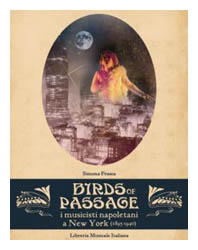
Birds of passage. I musicisti napoletani a New York (1895-1940)
(Lucca: LIM 2010; language: Italian)
Review by Giovanni Vacca

There is no doubt that Neapolitan Song has been a central genre in the development of what we now call ‘Popular Music’: probably no other urban song has achieved such a world-wide notoriety and certainly Neapolitan Song helped to expand the myth and the appeal of the city of Naples itself pretty much everywhere. How many among us, though, know about that ‘branch’ of Neapolitan Song that happened to find its way up in the United States since the beginning of the 20th century? Continue reading
Category Archives: News
Bethany Klein (2009) As Heard on TV: Popular Music in Advertising
Bethany Klein
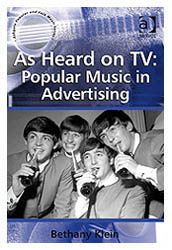
As Heard on TV: Popular Music in Advertising
(Aldershot: Ashgate 2009)
Review by Francesco D’Amato

The complex whole of ties between music and TV ads has been recently pushed to the foreground by the changes in the music production/commercialization system and correlated shifts from B2C to B2B business models. However it represents a relevant topic also for discourses about music circulation, changes in musical experience and how such processes join the aesthetization of daily life. Continue reading
Stan Hawkins (2009) The British Pop Dandy
Stan Hawkins
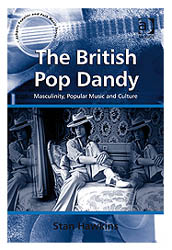
The British Pop Dandy: Masculinity, Popular Music and Culture
(Aldershot: Ashgate 2009)
Review by Nathan Wiseman-Trowse

In 1999 the British pop band The Divine Comedy released one of their most successful singles ‘National Express’. Secreted away as a B-side on the second CD single was a wonderfully wry and affectionate Noël Coward pastiche ‘Overstrand’. ‘Overstrand’ told the story of a Londonite coveting a well-to-do address in the metropolis to such an extent that he is willing to pimp himself to a ‘dirty old man’, murder a young woman in the Thames or even write for the Evening Standard in order to get his ideal, bourgeois home. Neil Hannon’s clever take on Coward marks out a clear link not only to a tradition of British comedy songs that have their roots in music hall, but he also connects himself, if somewhat archly, with a dandified persona that manifests itself throughout British popular culture, and British popular music specifically. Continue reading
Gerd Bayer (2009) Heavy Metal Music in Britain
Gerd Bayer
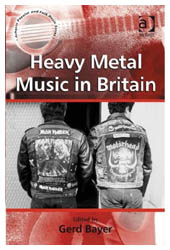
Heavy Metal Music in Britain
(Surrey: Ashgate 2009)
Review by Michelle Phillipov

Heavy metal is one of popular music’s most enduring and commercially successful genres. Emerging in the late 1960s, metal has since undergone numerous transformations, from massive arena spectacles to obscure underground subgenres. Despite its longevity and sustained popularity over the past four decades, metal has enjoyed only limited scholarly attention. It was not until the early 1990s — over 20 years after the genre’s inception — that a significant body of scholarship began to emerge. But even then, the critical literature on metal has remained noticeably less than for other major musical genres and, significantly, it has also remained noticeably less favourable. Metal has been too often dismissed as conservative and reactionary; its apparent substitution of escapism for political commitment has contributed to a dominant stereotype of the genre as less empowering, less culturally significant and less worthy of study than other more straightforwardly ‘progressive’ alternatives. Continue reading
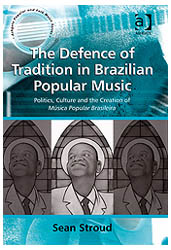
Sean Stroud (2008) The Defence of Tradition in Brazilian Popular Music
Sean Stroud
The Defence of Tradition in Brazilian Popular Music
(Hampshire: Ashgate, 2008)
Review by Alvaro Neder

Stroud’s study “examines how notions of what constitutes Brazilian popular music have been constructed over a period of forty years or so since the mid 1960s” (p. 1). Under the “distinct impression” that “the influence of an essentially conservative group of writers and journalists . . . continues to exert a particular influence on public perceptions of a tradition of national popular music” (ibid.), the author aims to consider the role of these and other actors (the record industry, the broadcasting industry, the state, academics and individual researchers) who have shaped current notions of what is understood as Brazilian popular music, and what isn’t. One of his primary intentions is “to identify the influence of those actors in delineating the parameters of Brazilian popular music, and more particularly the construction of a tradition within the wider sphere of popular music as a whole, that is, Música Popular Brasileira (MPB), the socio/cultural/musical movement that has dominated the artistic scene in Brazil since the mid 1960s” (pp.1-2). Continue reading
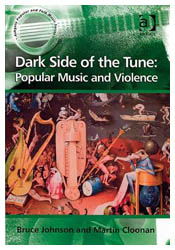
Dark Side of the Tune: Popular Music and Violence
Bruce Johnson and Martin Cloonan
Dark Side of the Tune: Popular Music and Violence
(Adlershot: Ashgate 2008)
Review by Carlo Nardi

In his book The ragas of North India, Walter Kaufmann reports a conversation he had in 1934 with an eminent classical musician in then Bombay. On the basis that a rāga performed at a wrong time is inauspicious, the old man expressed his sense of frustration in these terms: “Do you know that you people in the West will soon experience a most terrible disaster? And do you know why? […] Because you people in the West abuse music and perform it at wrong times and occasions! You play funeral marches and sing dirges when there is no funeral and no cause for sadness, you sing love songs and spring songs when there is neither love nor spring, you play nocturnes during the day, wedding music when there is no wedding. How long – he roared – will the universe tolerate this abuse of music, music, mind you, a most sacred thing?” (Kaufmann 1968, p. 18). Continue reading
Twenty Years After: A Review Essay of Musicological Identities
Michael W. Morse
Twenty Years After: A Review Essay of Musicological Identities (1)
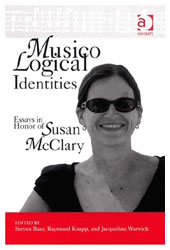
Steven Baur, Raymond Knapp, and Jacqueline C. Warwick (eds)
Musicological Identities: Essays in Honor of Susan McClary
(Aldershot, England; Burlington, VT: Ashgate, 2009) (2)
i
It has been nearly twenty years since the publication of Susan McClary’s provocative Feminine Endings. The appearance of a festschrift, with contributions from her most reliable students and acolytes, presents a suitable occasion to rethink the contribution to musicology of McClary and her school. I believe, first of all, that we can speak straightforwardly of a ‘school’. There are a number of important orientations, principles if you will, that unite these authors in their diversity, marking them together ideologically, and apart methodologically from other versions of musicology; they form a major strand of the so-called New Musicology® (3). Historically, perhaps first among these principles were regular and fervent proclamations of ideological distance from (and hence disinterest in) ‘traditional’ musicology and its outmoded scholarly paradigms; such edicts often took the form of tabular lists of the virtues of ‘us’ and the flaws of ‘them’ (4). Musicology’s paradigm—the singular is deliberate—is considered methodologically superseded because it ignored social context in favour of a chimerical abstract called ‘the music itself’, and morally outdated because it espoused elitist canons of white male privilege, intellectually as well as musically. Continue reading
Carys Wyn Jones (2008) The Rock Canon
Carys Wyn Jones
The Rock Canon: Canonical Values in the Reception of Rock Albums
(Aldershot: Ashgate, 2008)
Review by Maria Hanáček

The ongoing debate over the concept of a Western canon keeps various disciplines occupied and popular music studies certainly are no exemption. This academic debate is not the main frame of reference of this book, though. It is concerned with the emergence of canons – seemingly a high art concept – in popular culture and examines the extent to which canonical models from literature and classical music inform the reception of rock albums.
The study focuses on ten albums repeatedly appearing in “greatest albums” lists. The term “rock”, however, is applied very broadly here to “music defined primarily by albums”, thus this top ten includes not only the Beatles and the Rolling Stones but also Marvin Gaye and the Sex Pistols. (This definition appears quite plausible if one considers that “classical” concepts and values are most likely to be found in albums, which come close to the idea of a work of art. It seems a bit problematic, though, when later on an “ideology of rock” with narrower genre connotations is employed). Continue reading
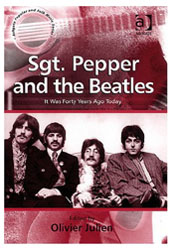
Olivier Julien (2008) Sgt. Pepper and the Beatles
Olivier Julien (ed.)
Sgt. Pepper and the Beatles: It Was Forty Years Ago Today
(Aldershot and Burlington: Ashgate, 2008)
ISBN: 978-0-7546-6708-7 (Paperback)
ISBN: 978-0-7546-6249-5 (Hardback)
Review by Alison Notkin

The Beatles are a popular band. During their reign as the “Fab Four” in the 1960s they were a popular band, and thirty-eight years after their ten-year career ended, they are still a popular band. More books have been written about the Beatles than any other band, ever. They were the first band to “warrant” serious musicological writing, and in fact, are one of the only popular music groups to grace the pages of such auspicious publications as the Cambridge Music Handbooks (only the Beatles and George Gershwin have had this honour so far). Music-lovers I meet often tell me that the Beatles are by far the best band that ever existed, and certainly, I, who spent hours of my 1970s and 80s childhood, locked in my basement, listening to records and pretending to be John Lennon, cannot contest that statement. Come to think of it, it is because of the effect of this popularity that I am even here, writing this review that I jumped on once hearing what the topic of the book was. Continue reading
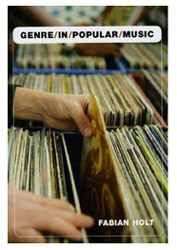
Fabian Holt (2007) Genre In Popular Music
Fabian Holt
Genre In Popular Music
(Chicago: University of Chicago Press, 2007)
Review by William Echard (Carleton University)

As Holt glosses it: “this is a book about the work of genre categories in American popular music” (p. 1). In part the book is a theorization of genre as a site of cultural practice, and in part a series of case studies. Holt’s own goals relative to the existing literature are to “bring genre scholarship closer to musical practice and experience,” and also to understand music genres “in the totality of social space” (p. 7). He adopts the term genre culture “as a concept for the overall identity of the cultural formations in which a genre is constituted” (p. 19). And given the complexity of social space, Holt feels that “the best way to [study genre] is not to develop an all-encompassing master theory, [but rather to] employ multiple critical models, explore plural narratives, and develop ‘small theories’ in relation to particular musical and social realities in a series of individually designed case studies” (pp. 7-8). Continue reading