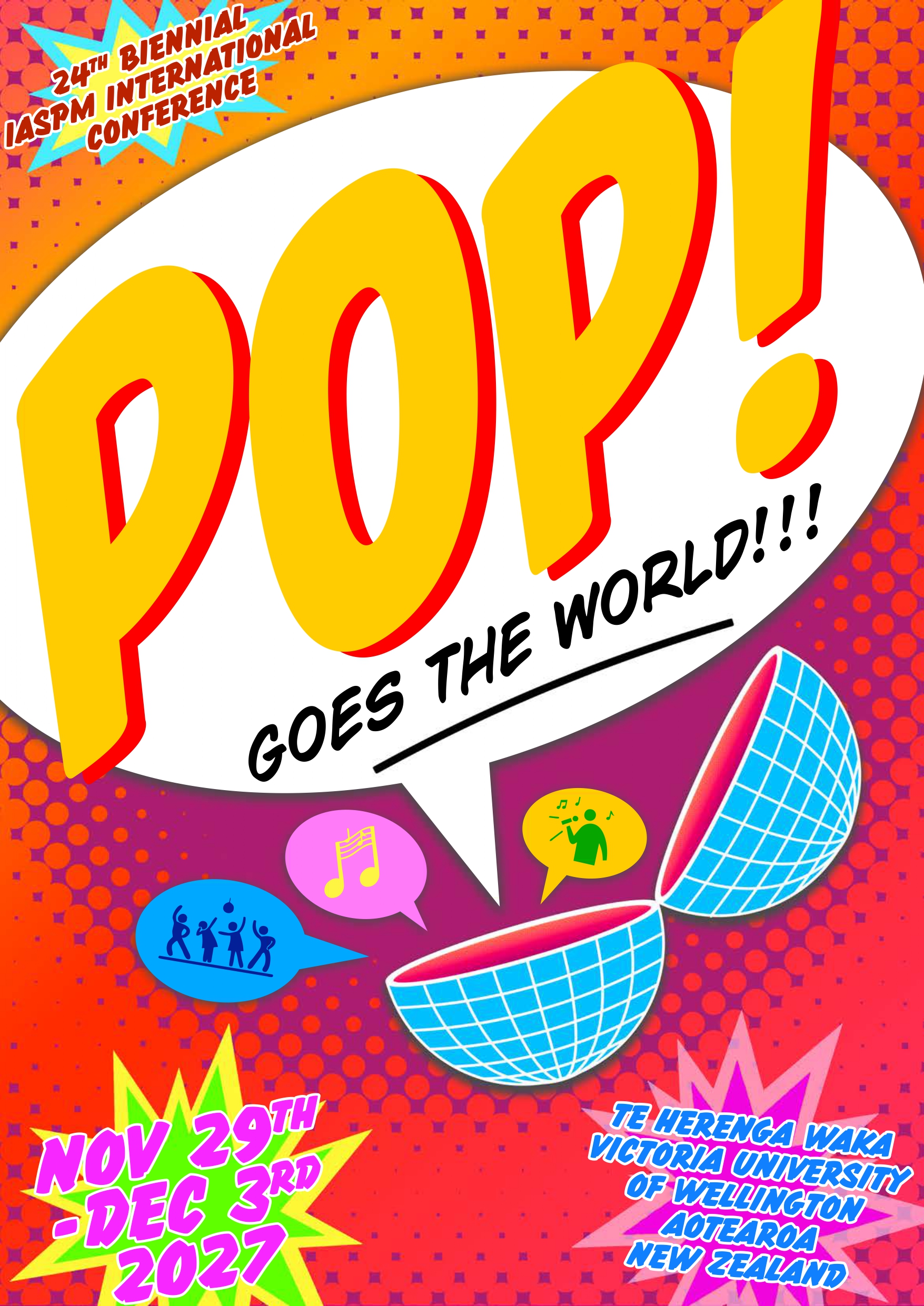
Pop! Goes the World!!!
24th Biennial IASPM-International Conference
Te Herenga Waka/Victoria University of Wellington
Te Whanganui-a-Tara/Wellington
Aotearoa/New Zealand
November 29-December 3, 2027
‘Pop goes the world’, Montreal’s Men Without Hats once sang. A quaint ditty about a couple, Johnny and Jenny, in a band named ‘The Human Race’ searching for meaning and salvation in a pop career. It served as a tribute to the power of popular music as a diversion, but also a possibility, an entry point into another way of life, another world. Riffing on this, the 24th biennial IASPM-International conference aims to honour the ‘pop’ in popular music but ground it, much like our song’s protagonists, in the human race. If one version of ‘pop’ is about the disposability, ephemerality and escapism of certain forms of popular music, other versions want to hold on to its pleasures, its ability to lift people up, through individual and collective empowerment. And, more so, ‘pop’, of course, also points to both a fragility and an explosiveness, a calamitous bursting. In a world riven with precarity, uncertainty, and the political vicissitudes of mercurial leaders, a world threatening to go ‘pop’ also carries with it a visceral sense of inescapable existential urgency.
These are just some of the many valences of ‘pop’, but they serve as starting points for a range of provocations and sites of interrogation. We can ask, for example, how do we, as popular music scholars, music-makers, listeners and fans, contend with these differently charged notions of ‘pop’? Across the many worlds we straddle, in our research, writing, creative practices, politics, pedagogy and our lives, how do these multiple senses of ‘pop’ resonate and synergize? What are some of the challenges and promises we face when we try to grapple with and harness the semiotic charges of ‘pop’ in these diverse arenas? What, we might ask at this critical juncture, are some of the ways popular music and popular music studies can be made to ‘pop’ in times of crisis?
With these prompts in mind, the organisers of the conference welcome papers and panels that draw on the following themes:
- Tutira Mai Ngā Iwi: Popular Music and Indigenous Imaginaries
- Clandestino: Music, Migration and Mobility
- Prisencolinensinainciusol: The Cultural Politics of Musical Translation
- Broken Pieces Shine: Popular Music and Disability
- That’s Me in the Corner: Making Music at the Margins
- Tous les garçons et les filles: Music and Young People
- Wir sind die Roboter: Music Technologies from Analogue to AI and Beyond
- Náttúra: Music, Environments, Ecologies and Sustainability
- 夜上海: Popular Music Historiography, Recording Industries, and the Politics of Genre
- Désenchantée: Music and Mental Health
- We Don’t Need No Education: Academic Life, Pedagogy, and Popular Music
- Apesar de você: Local and Global Activism, Protests, and Popular Music
- 하루하루: Popular Music and the Everyday
- Life in One Chord: Performing and Producing Popular Music
The organisers also welcome papers and/or panels on popular music that do not directly address these themes.
We are seeking abstracts of 200-250 words. Please format them as either Word or Google Docs, not PDFs, and label them lastname_firstname. Abstracts should include 3-5 keywords, indicate 1-3 preferred themes, provide a brief bio (max. 100 words), and institutional affiliation, where applicable. If submitting a panel (3-4 papers) be sure to supply a panel brief and the abstract for each participating panellist. Practice-based presentations will be considered but may be subject to tech availability. Please specify your tech needs in your abstract, and we’ll follow up where necessary.
All presenters must be members of IASPM prior to the start of the conference. You can find details on how to join here: https://www.iaspm.net/how-to-join/
Abstracts can be sent to: iaspm2027@gmail.com. Submission deadline: December 1st, 2026. Applicants will be notified of acceptance no later than April 1st, 2027.