
Twenty Years After: A Review Essay of Musicological Identities

Michael W. Morse
Twenty Years After: A Review Essay of Musicological Identities
(1)
mcclary.jpg
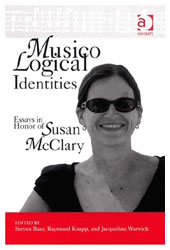
Steven Baur, Raymond Knapp, and Jacqueline C. Warwick (eds)
Musicological Identities: Essays in Honor of Susan McClary
(Aldershot, England; Burlington, VT: Ashgate, 2009) (2)

i

It has been nearly twenty years since the publication of Susan McClary’s provocative Feminine Endings. The appearance of a festschrift, with contributions from her most reliable students and acolytes, presents a suitable occasion to rethink the contribution to musicology of McClary and her school. I believe, first of all, that we can speak straightforwardly of a ‘school’. There are a number of important orientations, principles if you will, that unite these authors in their diversity, marking them together ideologically, and apart methodologically from other versions of musicology; they form a major strand of the so-called New Musicology® (3). Historically, perhaps first among these principles were regular and fervent proclamations of ideological distance from (and hence disinterest in) ‘traditional’ musicology and its outmoded scholarly paradigms; such edicts often took the form of tabular lists of the virtues of ‘us’ and the flaws of ‘them’ (4). Musicology’s paradigm—the singular is deliberate—is considered methodologically superseded because it ignored social context in favour of a chimerical abstract called ‘the music itself’, and morally outdated because it espoused elitist canons of white male privilege, intellectually as well as musically. Continue reading
Borderless Ethnomusicologies

The Society for Ethnomusicology
2009 Meeting
Call for Proposals

The Society for Ethnomusicology will hold its 54th annual meeting on November 19-22, 2009, in Mexico City, hosted by Centro Nacional de Investigación, Documentación e Información Musical Carlos Chavez del Instituto Nacional de los Artes; Escuela Nacional de Música, Universidad Autónoma de México; Escuela Superior de Música, Instituto Nacional de los Artes; Museo Nacional de Culturas Populares de la Dirección General de Culturas Populares; Escuela Nacional de Conservación, Restauración y Museografía of the Instituto Nacional de Antropología; Comisión de los Pueblos Indios; Fonoteca del Centro Nacional de las Artes of the Consejo Nacional para la Cultura y las Artes; and the Secretaría de Cultura del Departamento del Distrito Federal.
Continue reading

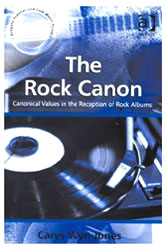
Carys Wyn Jones (2008) The Rock Canon

Carys Wyn Jones
The Rock Canon: Canonical Values in the Reception of Rock Albums

(Aldershot: Ashgate, 2008)
Review by Maria Hanáček
wynjones.jpg

The ongoing debate over the concept of a Western canon keeps various disciplines occupied and popular music studies certainly are no exemption. This academic debate is not the main frame of reference of this book, though. It is concerned with the emergence of canons – seemingly a high art concept – in popular culture and examines the extent to which canonical models from literature and classical music inform the reception of rock albums.

The study focuses on ten albums repeatedly appearing in “greatest albums” lists. The term “rock”, however, is applied very broadly here to “music defined primarily by albums”, thus this top ten includes not only the Beatles and the Rolling Stones but also Marvin Gaye and the Sex Pistols. (This definition appears quite plausible if one considers that “classical” concepts and values are most likely to be found in albums, which come close to the idea of a work of art. It seems a bit problematic, though, when later on an “ideology of rock” with narrower genre connotations is employed). Continue reading